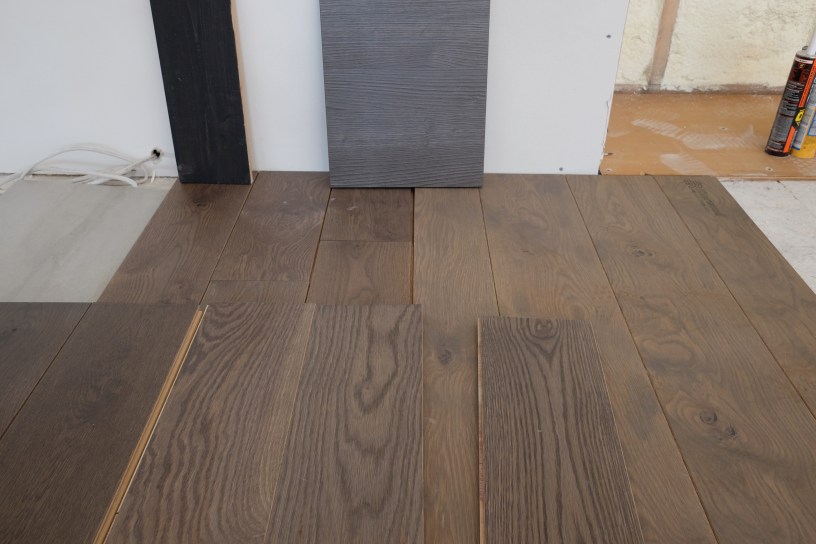
The infinitude of hardwood floor finishes
The architect, builder and I had to scramble to choose another hardwood floor finish. The architect recommended a hardwood floor finish last December, but due to some mix-up at the distributor, that finish wouldn’t have been available in time. Hardwood flooring installation is on the critical path, between drywall and kitchen cabinet installation. With drywall installation completed and cabinet installation due to start, we had no choice but to find another hardwood finish. The hardwood supplier sent samples of readily-available options, one of which I thought looked good. However, the architect didn’t think any of them were in harmony with the kitchen cabinet and other finishes, which were finalized in December, so he suggested another supplier.
When the architect and I visited that supplier’s showroom, I was quickly lost in the wide variety of options available. Tree species, solid vs engineered wood options, and the countless cuts, grades, stains, coats and plank widths all conspired against a timely selection from someone like me who likes to see everything that’s available and weigh the pros and cons of each. I wasn’t thrilled by this sudden, looming decision that had to be made as soon as possible. The situation made me look back on the dozens of choices I’ve had to make on this project so far.
The (somewhat) easier choices
Some of these choices I had to make very early. For example, I selected my appliances even before I chose a builder, so that I could have as much detail in the plan when builders bid on the project, which my chosen builder later included in our fixed-price agreement. Having chosen appliances early also facilitated the kitchen layout and cabinet design process. Compared to selecting a hardwood floor finish, choosing appliances was easier for me because their attributes are more objectively measured, for example, the capacity of a washing machine or fridge. Once I determined which attributes were important to me, I could narrow down my options. I visited appliance stores to compare the look and feel of my shortlisted units. I used several online sources such as Consumer Reports and appliance reviews on YouTube to research attributes that can’t be readily experienced firsthand, such as durability, performance and noise levels. The features and technology in most appliances also don’t change much, so I wasn’t concerned about making my selections over a year before they were to be installed. I’m sure I’m not missing out on a washer/dryer that also folds my clean clothes.
I also had to choose my plumbing fixtures early, but not before I picked a builder for the project. These had to be finalized during framing so the builder could order the appropriate in-wall valves and systems for toilets, faucets and the like and install them during plumbing rough-in. As with my appliance selections, I researched the attributes of plumbing fixtures, chose which attributes I most cared about, and used them to filter my options. I found build.com to be very useful for this purpose. I briefly considered matte finishes for faucets and shower heads to match the matte surfaces throughout the home, but I couldn’t justify the cost premium so I decided to stick with old-school, tried-and-tested polished chrome for bathroom fixtures.
When the pandemic hit, my builder began ordering the items needed to complete the project earlier than he normally would have, to mitigate potential supply shocks. This meant I had to accelerate my selection of lighting fixtures. The architect had already specified the recessed ceiling lights, so I only had to choose pendant lights for the entry, dining area and kitchen island, and a wall-mounted bedside lamp. This wasn’t as easy as choosing appliances and plumbing fixtures, since there aren’t that many objective attributes to help me narrow down the lighting options. I went through hundreds of lamps on several websites. The architect was less helpful here, offering advice only on the size of one fixture (the length of a linear pendant relative to the kitchen island). He broadly acknowledged my selections with a curt and non-committal “Those should work”. I was expecting him to have a more detailed lighting plan, or at least have a stronger opinion on the style of the fixtures, which could have reduced the amount of time I spent searching through all the options. It’s safe to say I won’t be looking at any options for pendant lamps for many years to come.
The hardest choices to make
In spite of how much time I spent choosing appliances, plumbing and lighting fixtures, these weren’t the hardest choices I’ve had to make so far. The hardest choices–those I’m most likely regret later–have been on things that:
- Have a lot of options to consider
- Cost a lot to change later
- Can’t be sampled nor readily experienced before project completion
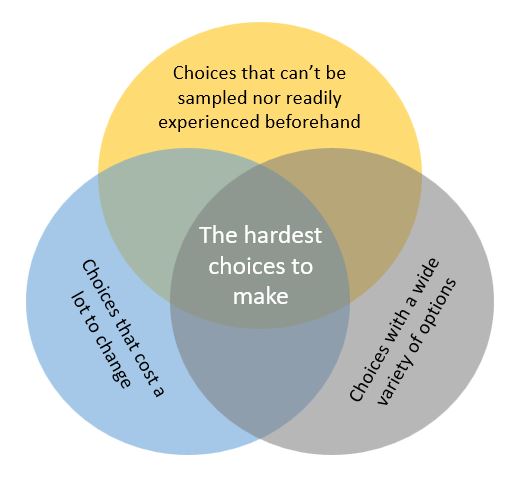
One of these was choosing the built-in cabinetry, especially for the kitchen, which I would use on a daily basis after I move in. The architect wasn’t that helpful here either, only saying that there are many suppliers out there. Cabinetry is a major line item in the budget, accounting for about five percent of the total project cost, and a delay in cabinet installation would have a significant impact on the project timeline. Though I was able to compare the quality of the hardware, finishes, and build of three cabinet suppliers, which led me to choose the German supplier, it was hard for me at the time to picture how their cabinets would fit into the overall functionality and appearance of my new home.
Another difficult choice was for the heating, ventilation, and air conditioning system (HVAC). This had to be made very early in the project and would have been about five percent of the project cost before I decided to do away with in-floor heating for the concrete ground floor, instead opting to only have a forced-air system to save on cost. While visiting the site, which doesn’t have the HVAC fully installed, I’ve noticed that it’s much cooler downstairs than upstairs, so I’m somewhat anxious about the cost to heat the rooms downstairs in the winter once the HVAC is operational.
The choices that made other choices easier
According to this framework, choosing an architect and a builder for my project should have been the hardest ones I’ve had to make. The choice certainly checks all the boxes: there were other architects and builders I could have chosen (especially since I was willing to wait); when I chose them, I didn’t really know what it was going to be like to work with them (only how different architects approach the design phase, which I described earlier in this blog); and it would be expensive to switch to a different architect or builder. But choosing an architect and a builder wasn’t all that difficult for me, perhaps because the options I had at the time were so starkly different that I easily eliminated all other options, in the case of my architect for his design and vision, and in the case of my builder for his lowest cost estimate, willingness to sign a fixed-cost contract, and approachable demeanor. Though there have been ups and downs ever since, I don’t regret my decision. More than that, I would work with my architect and my builder again on another project. They have delivered high-quality work so far, and have earned my trust.
It was this trust that eventually made the hardwood selection much easier, which I left entirely to my architect’s discretion. He also chose the bathroom tile, quartz counter top, wall paint, and exterior siding stain. (He did leave the bedroom accent wall paint to me, for which I found samplize.com to be indispensable.) Unknowingly to me when I made them, some choices made others much easier.
 The Bespoke Home