
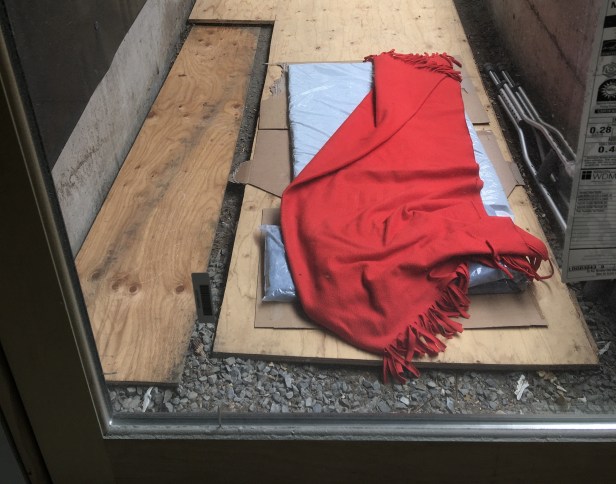
I got an e-mail from one of my neighbors last week telling me that a homeless person was sleeping at the construction site. She said the homeless man didn’t appear to be attempting to break in; he was just sheltering under the overhang outside my back door. I went to the site to talk the homeless man into moving to a shelter but I only found some bedding and a pair of crutches. I left him a note on a box of fried chicken telling him it wasn’t safe to stay at a construction site, but it remained untouched a few days later so perhaps he had moved on and left his stuff behind. The builder will install barriers to prevent others from taking up temporary residence at the site. With all the doors and windows installed, the home itself is fairly secure. Our immediate concern is making sure no one gets injured at the site, homeless or otherwise.
I thanked my neighbor for letting me know about the homeless person. Although I usually visit the site once a week, I was glad someone else was also keeping an eye out. I met her (who shares my property line to the south) last year soon after my builder began excavating the site for the foundation. She has a rockery wall abutting my property, which would connect to a retaining wall supporting my fence. My builder promised to restore to the rockery to its original condition after construction. Looking back, we involved her in the project just as we needed to.
In contrast, I met the family next door (with whom I share the property line to the west, and from whom my property was sub-divided) much sooner. I introduced myself to them soon after I purchased the lot almost three years ago. Because they were going to be the most impacted by the construction, I decided to involve them early in the project. My architect and I shared the design and plan with them before it was available for public review. They asked us to confirm that we were within the height restriction, which we did. The design largely preserves the view from their second floor. We also needed their authorization for temporary grading into their property in case the soil wasn’t stable enough to support a vertical cut within my property. They granted it after seeking professional advice, which helped us avoid any delays in the permit process. The soil turned out to be stable enough so the temporary grading wasn’t needed.
Soon after I chose a builder, I introduced him to them. My builder has done a great job keeping them informed of major disruptions, for example when the cement truck had to occupy the street temporarily to pour the foundation. My builder even offered to pressure wash their driveway and siding of dust after construction is done. They let us plug into their electrical outlet for a few days, before the power utility connected the site to the grid. Before I found the Cam-Do solution (hit the “time lapse” tag below), I briefly considered asking if they would be willing to host my time lapse camera, but ultimately decided against it. I imagined they would be concerned about privacy since the GoPro has a microphone, even though it wouldn’t be used since the camera would only be taking still photos of the construction. I would also have offered to pay for the power it consumes. If asked, would I host someone else’s time lapse camera? I suppose it depends on how obtrusive it is. Given my own desire to record the progress of construction, I would certainly understand why someone else would want to.
I have since met more of my soon-to-be neighbors. One of them expressed passing concern over supply trucks idling in the street, more out of care for the environment than for the noise, which I relayed to the builder. Nevertheless, everyone I’ve met has been supportive of the project. They even planned to invite me to their annual summer block party (though that’s likely not happening this year due to the pandemic).
Before we broke ground, I thought about hosting a meet-and-greet, and inviting everyone on my street so my architect, builder and I could share the plan for the property and answer any questions. My builder didn’t think this was a good idea; he thought it would give them license to be more involved than they needed to be. The more measured approach we’ve done instead, bringing in my next-door neighbor early and waiting to engage others only as needed, has so far felt like the right approach to community relations. This could be tested soon when work begins on the sewer connection. We have opted to tie directly to the city’s sewer line (which will entail blocking part of the sidewalk) rather than tie to an existing party line that runs beneath my backyard (which would entail asking the neighbors on my street to avoid flushing their toilets for a few hours). But we may have to go to Plan B if for some reason we’re unable to connect to the city’s line directly.
 The Bespoke Home