
New home rising
It was fun to watch my new home take shape over the last few months. Over a year and a half ago, I took a leap of faith that my architect’s floor plans would result in spaces that I would enjoy living in. When the ground floor slab was completed three months ago, I looked at the floor space that would become two downstairs bedrooms (one of which I plan to use as an office) and resigned myself to the realization that they were going to be smaller than I imagined. Delineated and enclosed by the wood framing, the same two rooms now appear larger than I originally thought. At this point, it looks like they will suit my needs nicely. (My architect’s assistant warned me that they will appear to shrink after the drywall is hung.)
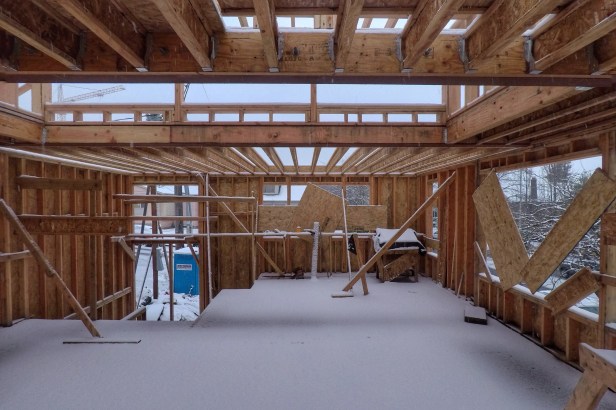
The framed main living area and kitchen on the second floor turn out to be an even bigger delight. Large north- and east-facing window openings, including above the main entry door, allow lots natural light in. A section of the nine-foot high ceiling rises a few more feet in what my architect calls a light box, which would sit above the living and dining areas. Openings for clerestory windows on the north and south sides of the light box bring even more light in. On the south side of the space, light floods down through the light well. I wish I have the same amount of awe and gratification every time I enter this space, long after I move in.
Structural steel
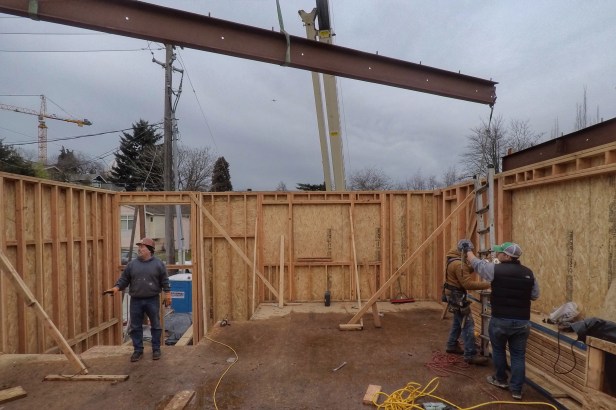
Although the home is mostly wood-framed, steel beams and posts were needed to support the light box and clerestory windows over the living room and also the second floor where it cantilevers over the backyard. I wanted to watch the steel elements as they were craned into place, but unfortunately I couldn’t make it to the site that day due to work commitments.
Soundproofing & window upgrade
During framing, we considered ways to mitigate traffic noise inside the home. An arterial road along the east side of the property gets quite busy, especially during the morning and evening commute. This was a factor in the lender’s appraisal of the project’s value, so I was open to upgrading the home’s soundproofing thinking that the added cost would accrue value to the project.
Rather than hire an acoustic engineer specifically for my project, the architect shared an existing report on another project of his that was on a busier street. I did some measurements using several free apps I downloaded on my phone, which showed similar noise readings as those in the report. Beyond what was already specified for my home, the report recommended two layers of 5/8-inch drywall, one of which must be sealed top and bottom with resilient caulk, and windows of an outside-inside transmission class (OITC) of 32. OITC measures the amount of sound (in decibels) absorbed by a window or other structure, weighted towards low-frequency sound such as traffic noise. In order to achieve that, we had to switch to a different line of windows double the cost of what the builder included in his lump sum contract. The total cost of the soundproofing upgrade, including the extra layer of drywall, will add 2% to the project cost.
The architect at work
During framing, the architect also resolved how the external siding, windows and framing all come together around the main entry way at the front of the home. Apart from some framing changes, this also resulted in the addition of a steel beam under the main entry door and adjacent window.
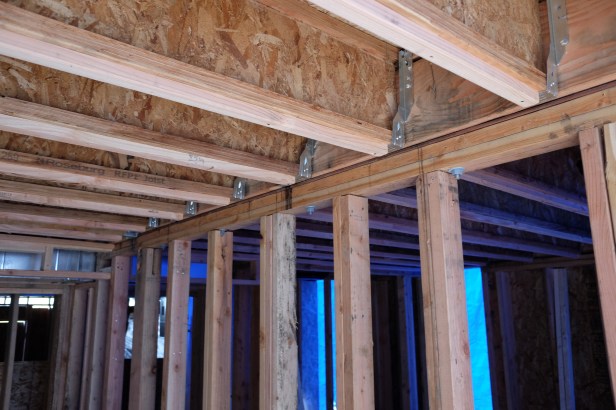
The architect also asked the builder to add one-inch spacers under the joists above the ground-floor bedrooms so that the ceiling lines up with the cantilevered second floor directly outside. This would result in the windows entirely framing the view of the backyard rather than have a layer of drywall above the windows. At first I wasn’t going to agree to the change, thinking it too inconsequential, but after they explained it to me I couldn’t “unsee” the ceiling that didn’t line up with the overhanging roof outside. Thankfully, the slightly lowered ceiling is only adding 4/10 of a percent to the project cost. Still, I’m beginning to think that some of the value an architect brings is in details I would not have otherwise noticed until it was explained to me.
Time lapse video
Here’s the time lapse footage of the framing. Notice the trees change as fall turned into winter. In hindsight, I should have shortened the interval between frames. Though that would have resulted in having to edit out more footage where the structure isn’t changing much, there would have been more footage of the more interesting work, such as the placement of steel beams with the crane.
 The Bespoke Home