
The wish list
Before the architect began designing my home, he asked me to complete a six-page questionnaire which included things about my current home, such as:
- How I use my current home on a daily basis
- How often I socialize at home and with how many people
- How much furniture, books, art, gear and other stuff I own
- How I use indoor and outdoor spaces
- How the use of my home changes with the seasons
…as well as things about my new home, such as:
- What qualities my new home should have (for example: simplicity, luxury, calmness)
- How many rooms it should have
- How the rooms should relate to each other (for example, whether the dining area opens to the outdoors)
- What surrounding homes and features around my property I would like to see or not see
- What my budget is
Completing the questionnaire was a lot of fun and I dove into it with gusto. Limited only by the maximum height and square footage I’m allowed by code to build, I was free to think about what I wanted in my new home, unconstrained for the time being from design, budget and other considerations that will inevitably lead to compromises later. In its unrealized state, before a single line has been drawn on paper, a new home is all potential. It felt great.
At the same time, answering the questions led to some anxiety, as I thought about the things I may have missed that could turn out to be important later. It’s cheap to change things around on paper, not when a home is being built, so I felt pressure to think about every possible way I would be using my new home and how that might change in the coming years.
Besides wanting a home that’s bigger than my current one-bedroom, 770-square foot condo, I would like my new home to have:
- A master bedroom on the same floor as the kitchen and main living area
- A yard for my active dog to run and play in
- A garage so I don’t have to find parking by my home everyday
- A work space that’s separate from my bedroom
- Lots of storage for my many hobbies
- Ideally, a view of the mountains, lake and skyline to the east of my lot
After I completed the questionnaire, I met with the architect at his studio and we went over my responses for over an hour.
The prefab home I imagined
Meanwhile, I conveyed my wish list to the prefab builder through a SketchUp model I drew based on the floor plan I had chosen on their website. I previously tried to use the Home Design 3D app on my iPad but I couldn’t figure out how to add a second floor to it. I could draw two separate floor plans on the app, but I couldn’t be sure whether the stairs between the two floors lined up. In contrast, drawing a second floor was easy on SketchUp. What’s more, it’s free and easy to learn. I completed the drawing below of my new home with walls, rooms and even ready-made downloadable furniture within a day or two. Since the prefab builder’s designer is out-of-state, we used my SketchUp model to share ideas and tweak the floor plan over online meetings.
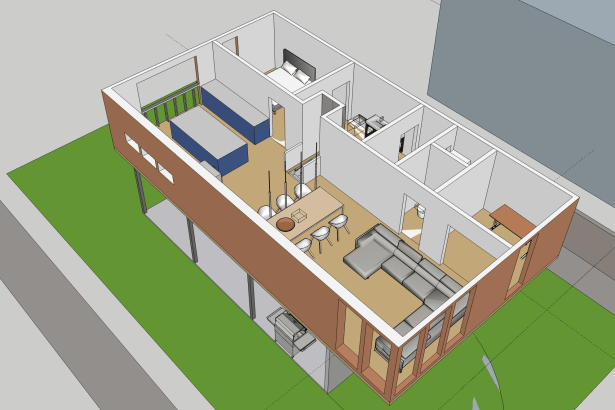
I also used Lego Architecture Studio to see how the prefab might look. It was certainly more tactile than SketchUp and it didn’t require me to learn any software. But it was much harder to get things to the right scale with Lego blocks and I couldn’t get as much detail as I could on SketchUp. It was loads of fun though.


 The Bespoke Home